The PEPR NumEco website is hosted on a Raspberry Pi 3 Model B+.
This choice may seem unusual at a time when many web services rely on large-scale infrastructures, but it reflects several objectives that are consistent with the spirit of the project.
First, the hardware was not purchased specifically to host this website. The Raspberry Pi devices were already available in the laboratory as part of a previous project. Rather than replacing them with new equipment, we chose to give them a second life.
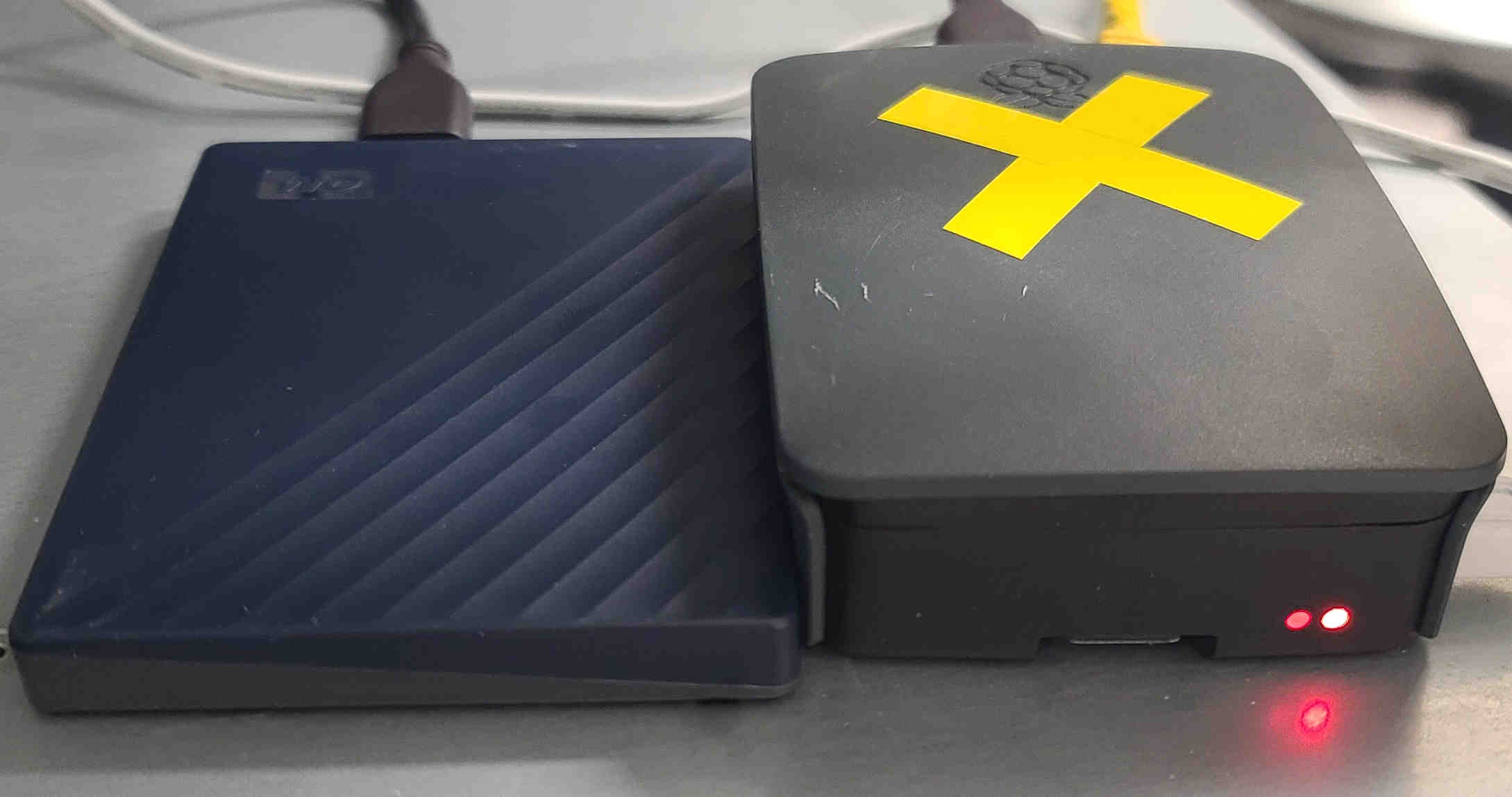
The same approach was applied to storage. Rather than purchasing a new drive, the platform uses a 2 TB Western Digital My Passport hard disk that was already available within the laboratory. The device had accumulated only a few dozen hours of operation and had never been deployed in production. Reusing existing equipment in this way avoids the environmental cost associated with manufacturing and transporting new hardware while remaining fully adequate for the modest storage requirements of the website. This choice contributes to the overall objective of extending the lifespan of existing equipment whenever possible.
A possible future evolution under consideration is to use this external hard drive to store part of the platform’s writable data. The goal is to reduce write operations on the microSD card, whose endurance is generally lower than that of a hard drive or an SSD, thereby improving the long-term reliability of the infrastructure.
Second, the actual requirements of the website are relatively modest thanks to the technical choices that were made. The site is generated statically using Hugo, a website generator that produces all HTML pages in advance. Unlike content management systems such as WordPress or Joomla, there is no need to execute application code or query a database each time a visitor accesses the site. This approach significantly reduces resource requirements, simplifies server administration, and limits the attack surface exposed to the Internet.
The website is served by Nginx, without a database and without complex dynamic processing during visits. Pages are generated beforehand and then simply delivered to visitors. As a result, a small and energy-efficient machine is more than sufficient to provide this service.
Platform Specifications
The server is a Raspberry Pi 3 Model B+ (revision 1.3) equipped with:
- a 64-bit quad-core ARM processor;
- 1 GB of RAM;
- a 64 GB microSD card used for both the operating system and website data;
- a 2 TB external hard drive currently dedicated to backups.
It runs Debian GNU/Linux 13 (Trixie) with a Linux 6.12 series kernel.
At the time of writing, the system uses less than 200 MB of RAM and occupies approximately 4 GB of the 64 GB of available storage. The processor temperature observed under normal operating conditions is around 42°C.
The entire software stack is based exclusively on free and open-source software.
Why This Choice?
This project does not aim to demonstrate that a Raspberry Pi is the ideal solution for every website. However, it does show that, in some contexts, it is possible to provide a reliable and comfortable service for users with a simple, low-cost, and highly energy-efficient infrastructure.
This approach also helps extend the lifespan of existing equipment and avoids the acquisition of new hardware when it is not necessary.
Questions, comments or suggestions?
If you have any technical questions, comments or suggestions about this platform or this website, please feel free to contact me at jean-christophe.mignot@ens-lyon.fr.